
Montreal Real Estate Market — Q1 2026
Q1 2026 shows a Montreal market that is stronger than expected, with demand returning quickly and an active spring ahead.

A start to the year that reveals more than it seems
The first quarter is always a particular moment in the real estate cycle. January and February are among the quietest months of the year, along with December. Activity is lower and transactions are fewer, and yet it is precisely in this low liquidity that the first signals for the rest of the year take shape. What the market reveals under these constrained conditions is not noise: it is structure. And in 2026, that structure appears stronger than it lets on.
Growing inventory, but two distinct markets
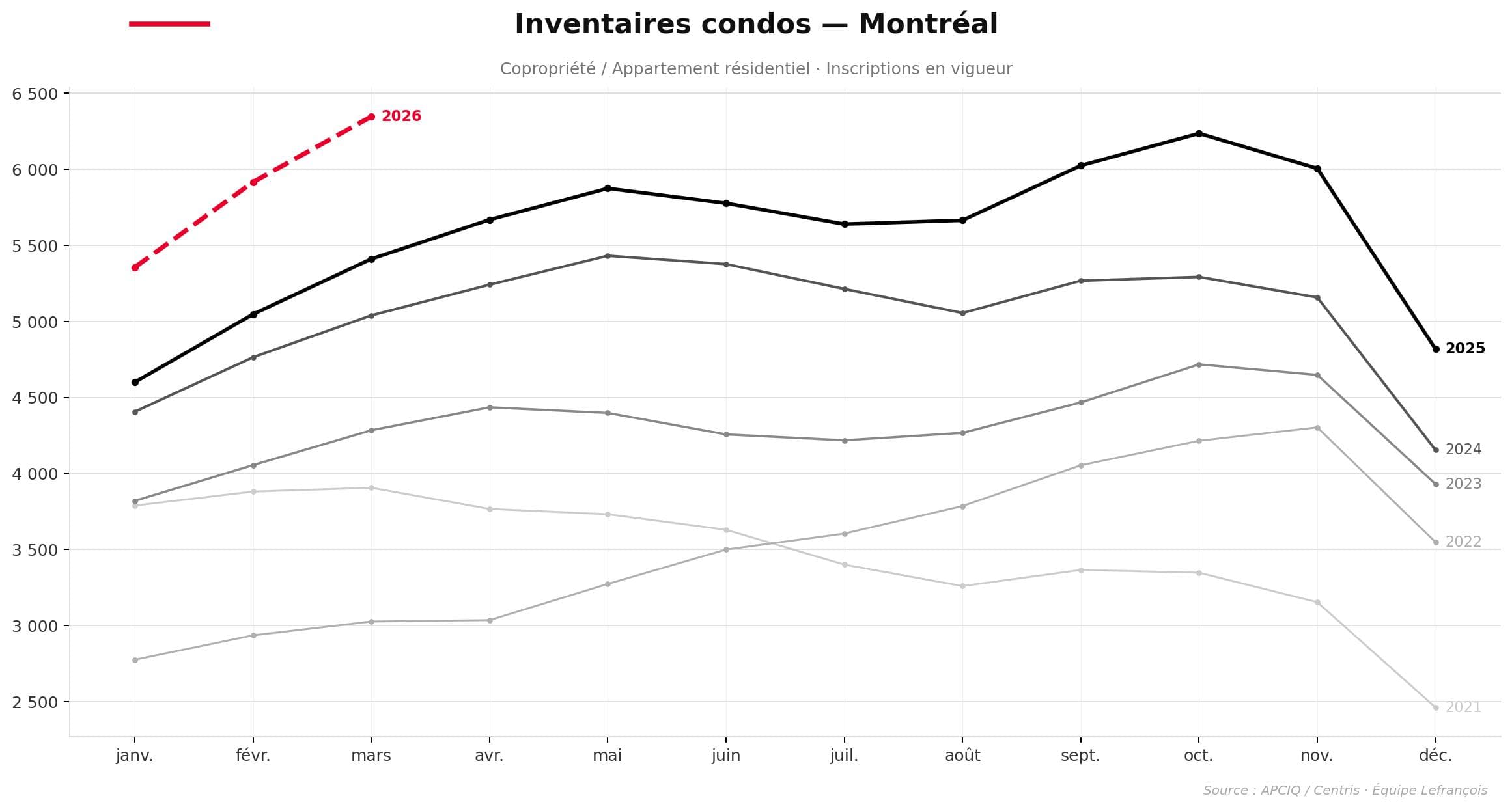
As every year, inventory dropped in December before rebounding at the start of the year. This cycle is normal. What is less normal is the size of the rebound, particularly in condos. Since 2025, the island of Montreal has been accumulating a volume of units for sale that keeps rising, driven by sustained construction.
Conversely, the single-family market remains constrained. There is practically no new construction anymore, which stabilizes supply and prevents any significant expansion of inventory. This structural divergence creates two parallel realities: a competitive, abundant condo market, and a house market where scarcity continues to support value.
This contrast can be summed up as follows:
- Condos: rising inventory, increased competition
- Single-family: limited inventory, constant pressure
- Overall effect: a fragmented market, hard to read without nuance
This distinction is essential, because it explains much of the behaviour observed in the other indicators.
The absorption rate: a strong signal as early as Q1
The absorption rate remains the most revealing indicator of the balance of power between buyers and sellers. At around 16 to 18%, the market is considered balanced. Above 20%, it tips in favour of sellers.
What the first quarter of 2026 shows is particularly clear. The single-family market saw a rapid rise in its absorption rate, reaching nearly 25% after a slowdown phase. This movement happened in just a few weeks, in February and March, which is an important leading signal for the spring.
On the condo side, the situation is more subtle. After stagnating around the equilibrium point for several months, the absorption rate recently crossed that threshold. This means that, despite high inventory, demand is very much present and capable of absorbing a significant share of supply.
Key takeaways:
- The single-family market is already in seller territory
- Condos are gradually emerging from a more passive market
- The recovery happened quickly, which strengthens its credibility
A more precise market: the end of overpricing
Another key element of the quarter is the behaviour of asking prices. After a period when sellers tended to overvalue their property, later forcing adjustments, we now see a narrowing between the asking price and the price obtained.
This phenomenon reflects a deeper change. Sellers are reading the market better, buyers are more willing to accept the prices offered, and transactions close with less friction. It is not a more aggressive market, but a fairer one.
A healthy market is rarely recognized by the speed of its growth. It is recognized instead by the quality of its adjustments.
Prices: a persistent divergence between houses and condos
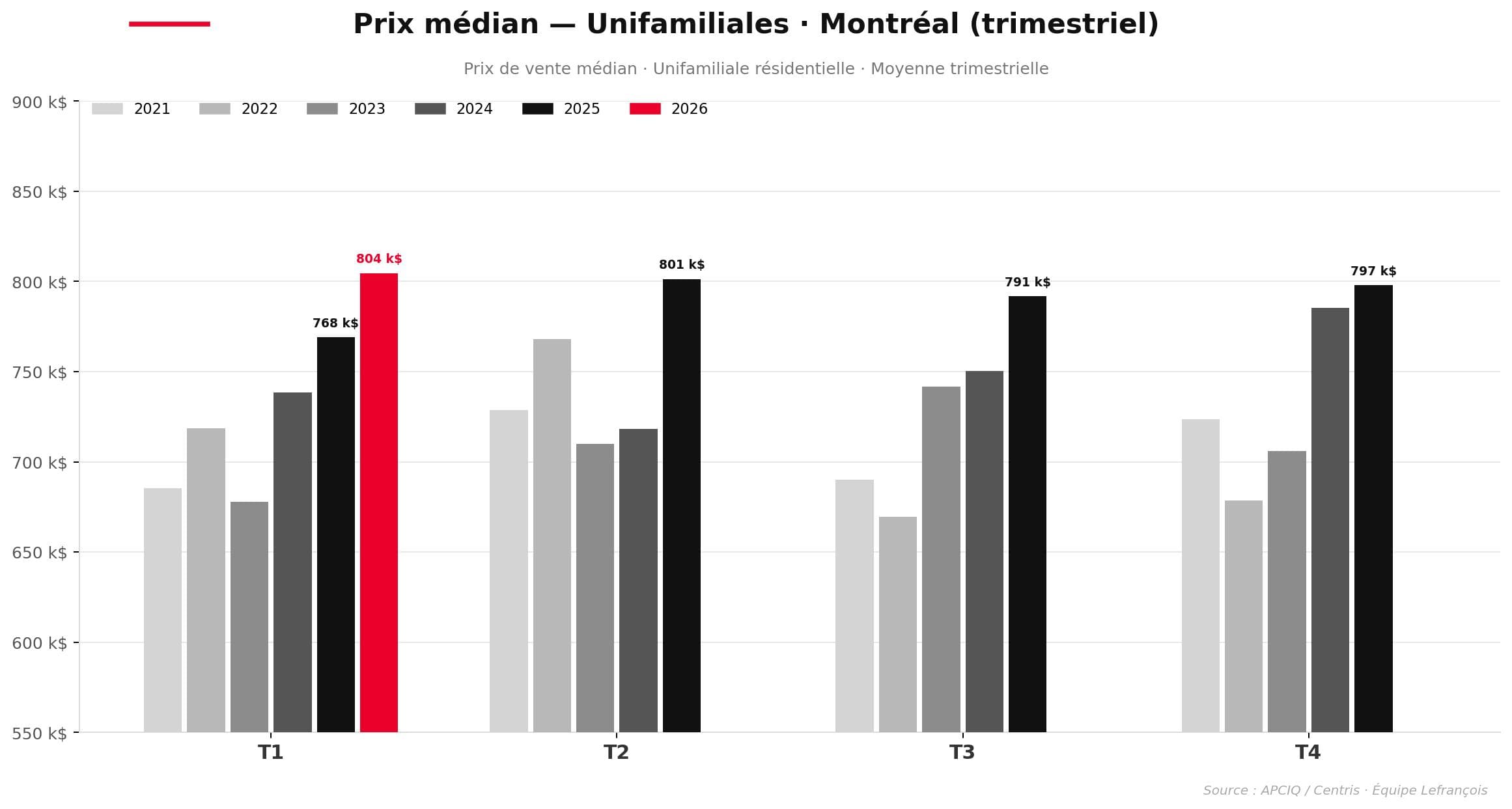
In terms of prices, the split between the two segments is confirmed. Single-family homes continue to trend upward. The start of 2026 even came close to certain historical highs, despite the winter season. This resilience is explained by a simple combination: constant demand and limited supply.
Condos, on the other hand, remain in a stabilization phase. For about three years, prices have moved little. The continued increase in inventory limits the market's ability to generate growth, which makes resale gains more difficult, especially in the short term.
But a change is beginning. The rise in the absorption rate, however modest, could set off a transition:
- Prolonged price stabilization
- Pressure still present on sellers
- But the first signs of a possible rebalancing
It will not be a rapid movement, but rather a slow reconfiguration.
Montreal vs. the suburbs: a gap that raises questions
Since the pandemic, Montreal has faced significant migration to the North and South Shores, fuelled by remote work. This dynamic contributed to a certain relative underperformance of the island.
Yet data from the first quarter of 2026 show a surprising phenomenon: a slight dip in prices in Montreal, while the shores continue to climb.
The gap between the markets has narrowed considerably. This convergence raises a simple but fundamental question: is it sustainable?
In the medium term, several factors suggest a possible reversal:
- Gradual return to the office
- Reassessment of centrality
- Natural limits to growth on the periphery
It is hard to imagine a market in which certain outlying areas durably outperform Montreal without a correction.
Luxury: an indicator of confidence
Finally, the luxury segment sheds light on something often overlooked. Historically more sensitive to economic cycles, it had shown signs of weakness since 2023. Yet the first months of 2026 point to a tightening of sale-to-list ratios in areas such as Outremont and Westmount.
This movement is significant. In real estate, luxury often acts as a leading indicator. When this segment stabilizes or recovers, it generally reflects an improvement in overall sentiment.
What we are seeing today:
- Less negotiation at the high end
- Better acceptance of prices
- A gradual return of confidence
Conclusion: a spring under positive tension
The first quarter of 2026 is not just a simple seasonal restart. It reveals a market in transition, where the fundamentals remain solid but internal dynamics are becoming more nuanced.
Single-family homes are confirming their structural strength. Condos are beginning to reposition. Montreal, despite some pressure, could regain a relative advantage in the coming months.
One external variable remains: the economic and geopolitical context. A deterioration could slow this momentum. But at this stage, the market's internal indicators point to an active spring, driven by real demand and rebuilding confidence.
This is not an overheated market.It is a market that is reorganizing itself.
Need help interpreting the market for your project?
Our team can help you understand what this data actually means for your project.
Related content

Verdun and Nuns' Island Real Estate Market: What Q2 2026 Reveals
Single-family prices up sharply, condo prices flat but more units on the market: Centris figures for Q2 2026 show two very different markets in Verdun.

Second Quarter in Montreal: More Choice, but Good Properties Still Sell Quickly
The second quarter of 2026 confirms a change of pace in Montreal’s real estate market. Buyers have more properties to compare, and sales are slowing.

Condos: Ahuntsic Holds Up While Montreal Catches Its Breath
While Montreal’s condo market is slowing, Ahuntsic continues to show resilience, with rising prices and demand that is absorbing the additional supply.