
Condos: Ahuntsic Holds Up While Montreal Catches Its Breath
While Montreal’s condo market is slowing, Ahuntsic continues to show resilience, with rising prices and demand that is absorbing the additional supply.

Ahuntsic holds up while Montreal catches its breath
You read the headlines. Montreal’s condo market is slowing, inventory is swelling, buyers are regaining the upper hand. And you are wondering, quite legitimately, whether all of this applies to your unit, on your street, in your area. The answer deserves better than a generality. So I went back to the Centris/APCIQ condominium data for the first five months of 2026, at two scales: the entire metropolitan area, then Ahuntsic alone. The two markets do not tell the same story.
What the metropolitan area is experiencing
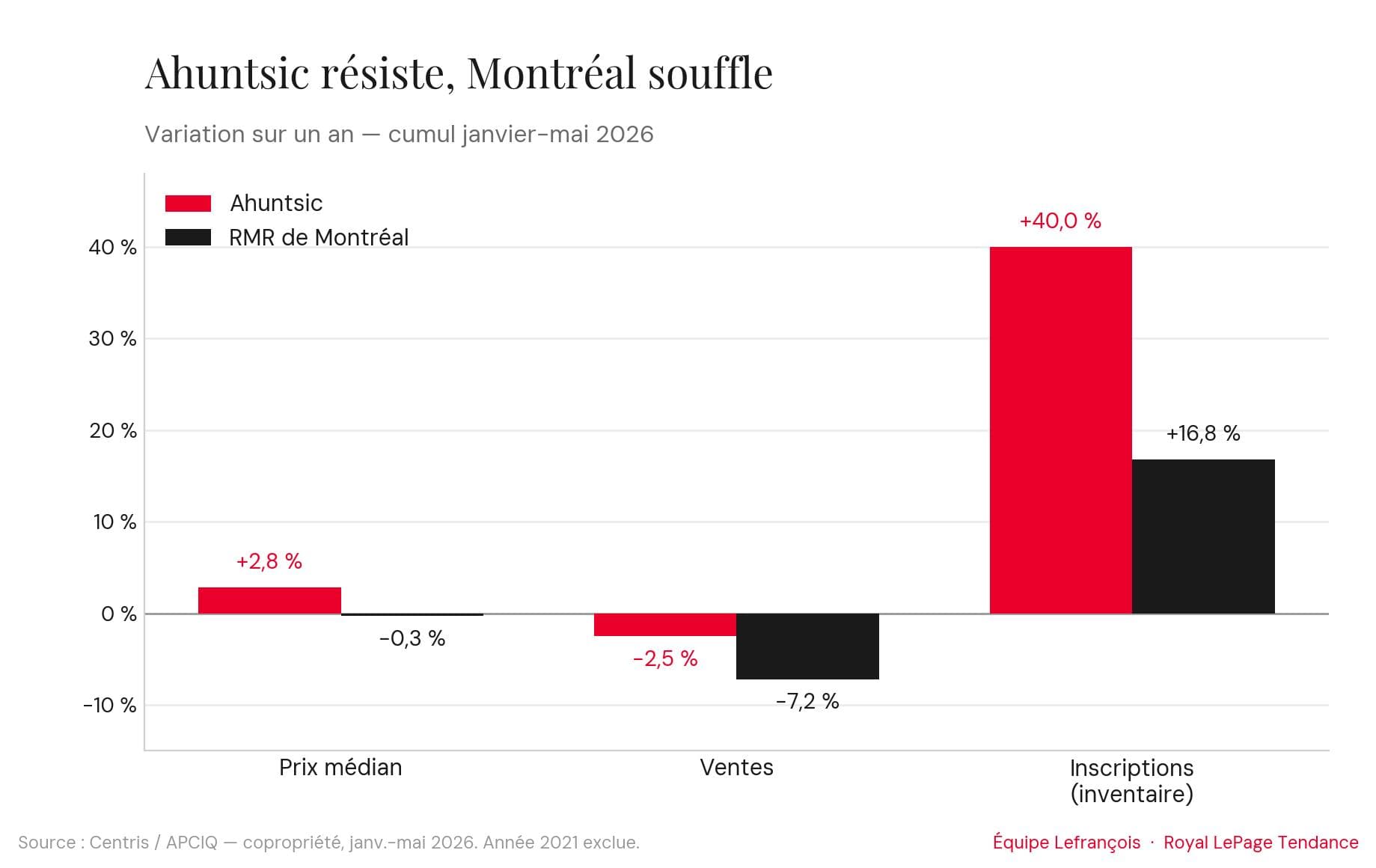
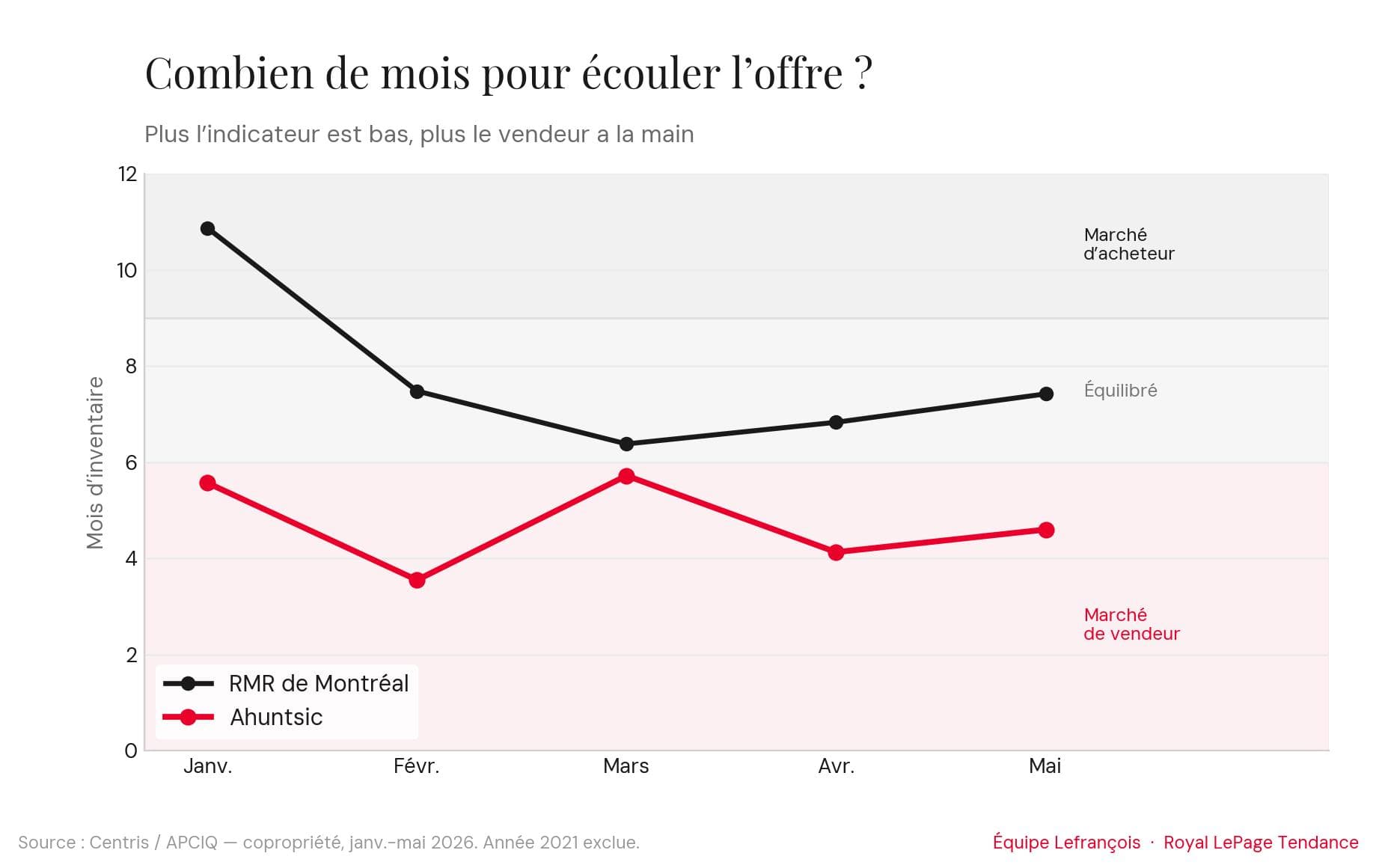
Across the metropolitan area, condos are clearly entering a rebalancing phase. From January to May 2026, sales fell by about 7% year over year, while the number of active listings jumped by nearly 17%. More supply, fewer transactions: the balance of power, long in sellers’ favour, is shifting toward buyers. In concrete terms, it now takes around seven months to sell off the metropolitan inventory, a level associated with a balanced market leaning toward buyers, not with the frenzy of recent years.
And prices in all of this? Surprisingly stable. The median price of a condo in the CMA held at around $476,000, a change of −0.3% year over year; in other words, flat, with a first sign of softness appearing in May. That is what “Montreal catching its breath” means: a market pausing to regroup, where supply is rebuilding faster than demand can absorb it.
What Ahuntsic is experiencing
Same period, same database, a different story. In Ahuntsic, the median condo price stood at around $433,000 over the first five months, an increase of about 2.8% year over year. While the metropolitan median declined slightly, yours, as an Ahuntsic owner, went up.
Volume confirms the trend. Sales in the sector remained nearly stable (only −2.5%, compared with −7% for the CMA). And the indicator I watch most closely, the ratio between available supply and the pace of sales, remains firmly tight: between 3.5 and 5.7 months of inventory depending on the month, compared with about 7 for the metropolitan area. Put simply, Ahuntsic remains a seller’s market where Montreal as a whole already no longer is.
The paradox worth pausing on
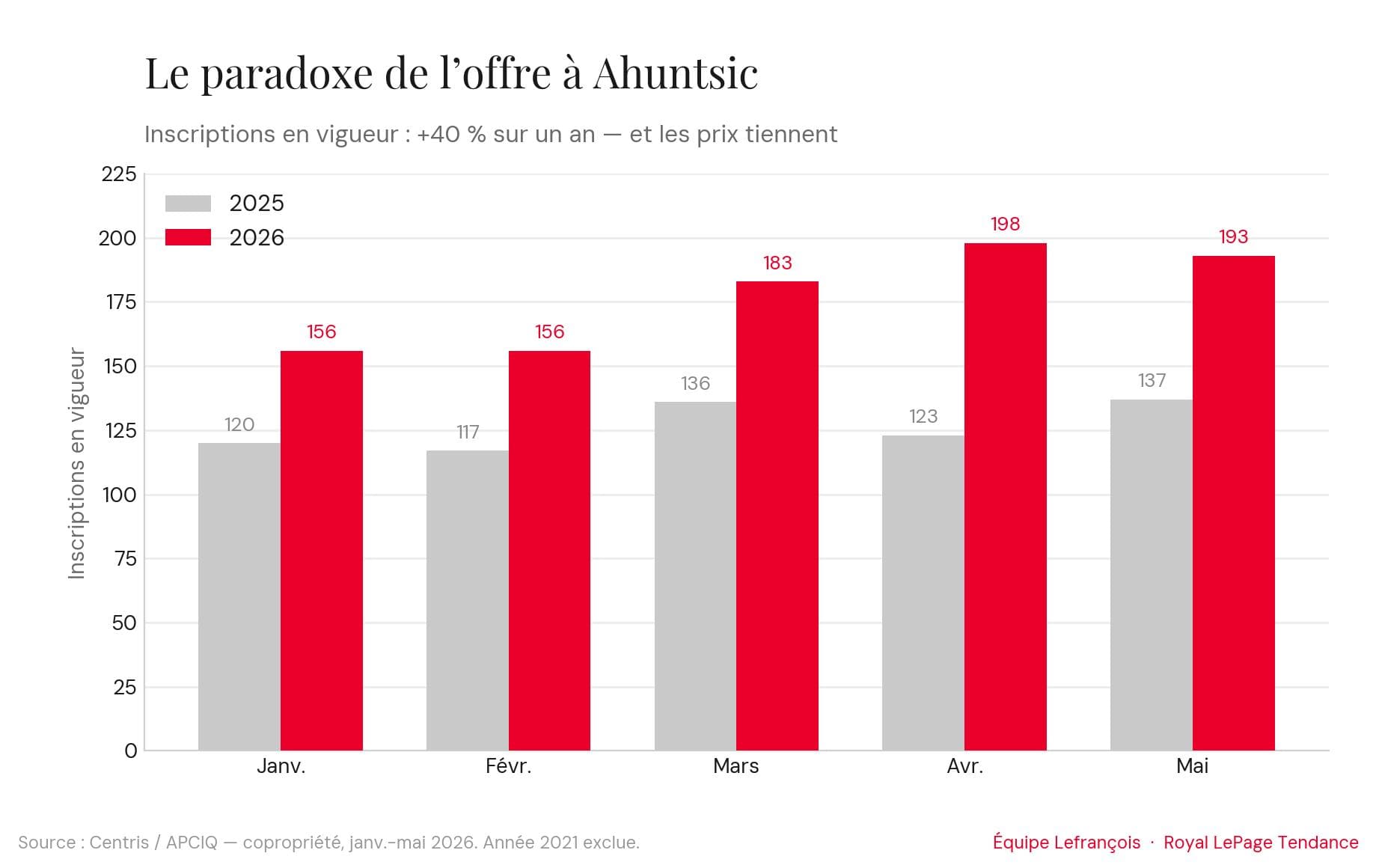
Here is the detail that makes this story interesting rather than simply flattering. Ahuntsic’s inventory did not rise slightly: it soared by 40% year over year, more than double the metropolitan increase. Economic logic would suggest that this wave of supply should weigh on prices. The opposite happened.
Why? Because local demand is still absorbing this additional supply. A market where listings nearly double, yet prices hold and selling times remain short, is a market whose demand is structurally solid. Supply is not the problem in Ahuntsic; it is simply finally showing up, and it is finding buyers.
Part of the explanation lies in a figure I find revealing: in 2026, a condo in Ahuntsic sold on average about 9% below the metropolitan median. This gap acts as a floor. In a context where buyers are becoming cautious again and looking for value, an area that offers a better entry point, while remaining connected to downtown by the Orange Line and close to Sauvé station, naturally captures the demand turning away from more expensive neighbourhoods.
An analyst’s word of caution
I would be remiss to leave you with only a triumphant reading, because Ahuntsic’s data call for caution. The sector records between 30 and 50 condo sales per month. At that volume, the median price for any single month jumps around: it showed +13% year over year in February, then −7% in April. These are not trends; they are statistical noise, the effect of a handful of atypical transactions on a small sample.
That is why I reason on the year-to-date total rather than on any given month, and why I am wary of any headline built on a single data point. (I also continue to exclude 2021 from my comparisons, a year too distorted by the pandemic to serve as a benchmark.) Ahuntsic’s increase of ~2.8% is real because it holds across the entire start of the year, not because one spectacular month inflated it.
So, is your condo gaining more value than elsewhere?
In 2026, yes, modestly, but genuinely. On both price and market tightness, Ahuntsic is outperforming the metropolitan area. Your asset has appreciated while the Montreal median declined, and it sits in a market that remains in the seller’s favour when the rest of the island no longer is.
One nuance, however, which follows directly from that 40% increase in inventory: the market now rewards positioning. The days when any unit sold within a few days above asking price are fading, here as elsewhere. A well-prepared, accurately priced property stands out quickly; another, poorly positioned in an inventory that has become abundant, waits. The gap between these two scenarios has never been as wide as in 2026.
A neighbourhood average is still just an average. To know precisely where your unit stands, based on its building, its size and its exposure, nothing replaces a reading of the comparables actually sold around you. That is exactly the kind of work I enjoy doing.
Marc Lefrançois, CFA Real estate broker — Équipe Lefrançois, Royal LePage Tendance
Data: Centris / APCIQ database, condominiums, January to May 2026, Ahuntsic sector and Montreal census metropolitan area. The year 2021 is excluded from comparisons.
Need help interpreting the market for your project?
Our team can help you understand what this data actually means for your project.
Related content

Ahuntsic Real Estate Market: What the 2025 Numbers Reveal (and How to Benefit)
Ahuntsic real estate 2025: sales up, listings down sharply, average prices rising strongly. A tight market that favours sellers.
Where Do Ahuntsic’s Single-Family Home Buyers Come From?
Ahuntsic’s buyers come mainly from the neighbourhood itself, from neighbouring central areas such as Villeray, Rosemont and the Plateau, and from the North Shore. The market is primarily local, family-oriented and little influenced by international buyers.
Why Ahuntsic Remains One of the Most Consistent Areas to Settle Down Long Term
In a Montreal where densification is accelerating, Ahuntsic retains a rare residential stability. For a long-term plan, this consistency becomes a genuine strategic advantage.