
Montreal Plex Market in Early 2026
The plex market remains solid in Montreal, but inventory is rising and some areas are starting to slow down. With interest rates possibly heading higher, reading your market correctly matters more than ever.

The Montreal plex market is entering a more complex phase. Not necessarily fragile. Not yet worrying. But clearly more nuanced than in recent years. After a long period when almost everything seemed to rise at once (prices, rents, confidence, speed of sale), several indicators are now starting to send a subtler message.
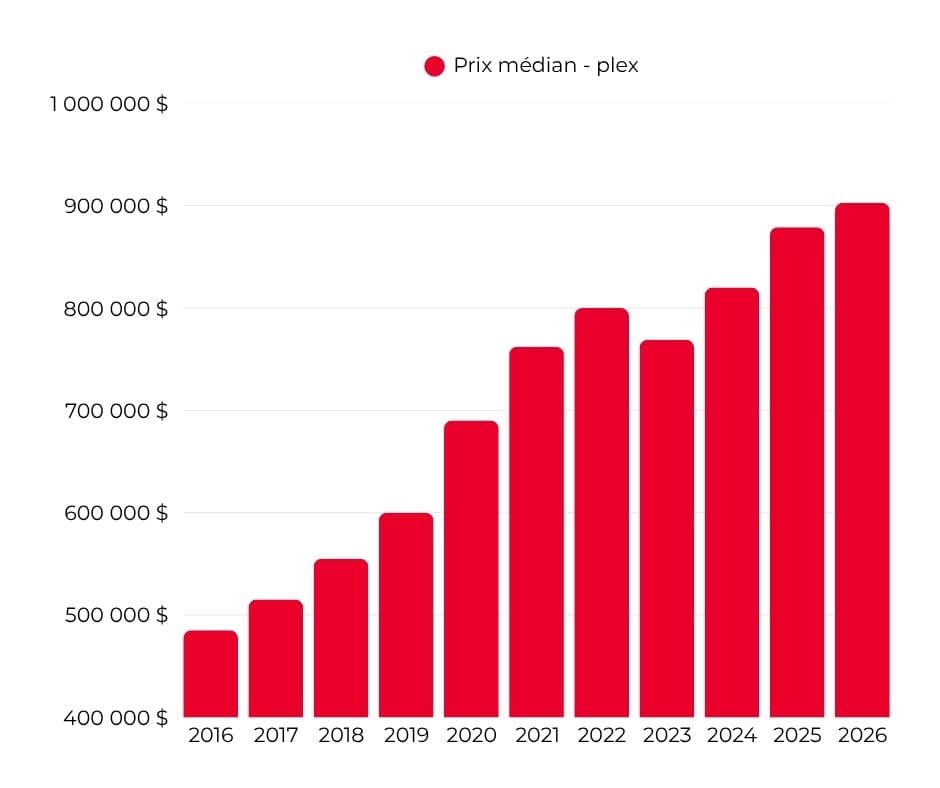
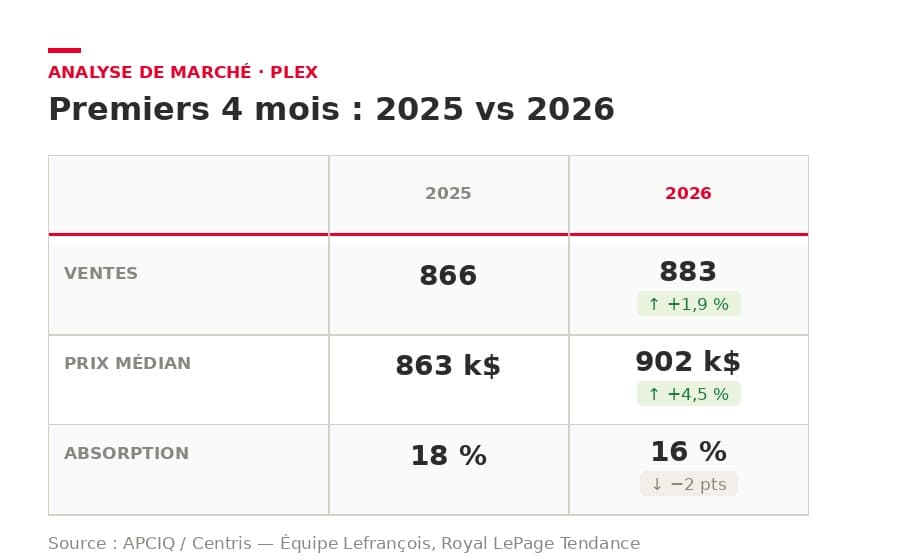
Since the start of 2026, plex prices in Montreal have continued to rise. The average duplex, triplex and fourplex now trades at around $902,000, compared with about $863,000 a year earlier. Sales also remain relatively strong, with a slight increase of about 2%. At first glance, then, the picture still looks very favourable. Yet behind this growth, several important shifts are under way.
The first signal to watch is the absorption rate.
It is probably one of the most important indicators for understanding a real estate market, because it measures the actual speed at which buyers absorb available inventory. In other words: how many properties find a buyer each month relative to the total number of properties for sale. And right now, that rate is gradually starting to slow.
Last year, the plex market was running at around 18% absorption. This year, it is closer to 16%. The difference may seem small, but in real estate, it is often these gradual shifts that change a market's dynamics before prices themselves react. We are still in a relatively balanced zone, but we are slowly moving toward territory where buyers could start to regain more negotiating power.
And this change matters. A plex remains a hybrid asset: both a residential property and a financial vehicle. That is precisely why interest rate hikes hit this segment harder starting in 2022. Yet despite that context, the plex market showed impressive resilience. Even before rates started coming down again, the segment had already begun to regain strength. In 2025, Montreal had a particularly solid year. The start of 2026 is still carrying that momentum. But several inflationary factors are once again putting significant pressure on the Canadian economy: oil prices, geopolitical tensions, tariffs and international trade disruptions.
And this is where the real estate market once again becomes deeply tied to the global economy.
The Bank of Canada has not raised rates recently. But if inflationary pressures persist, even if they are partly caused by external factors, it could become necessary to slow the economy to protect Canadians' purchasing power. For a plex owner, this kind of detail is not abstract.
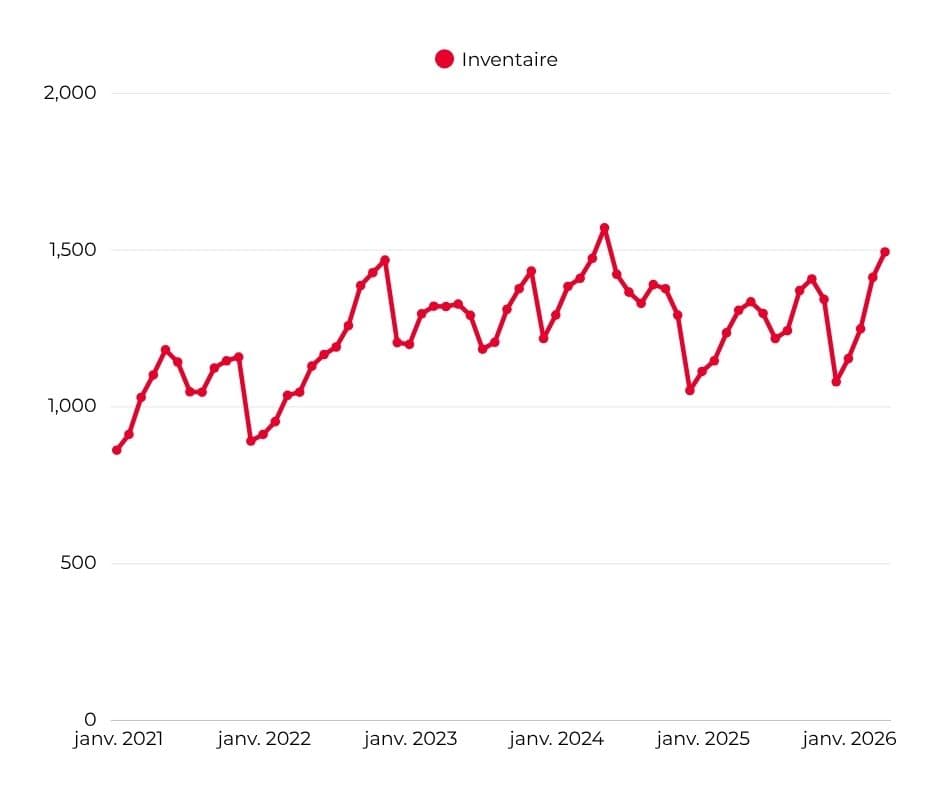
Inventory is now starting to rise significantly in Montreal. There are now nearly 1,500 plexes on the market on the island, one of the highest levels in recent years. For buyers, this brings more choice and more possibilities. But for sellers, it also means stiffer competition. In a market where absorption is slowing, not all plexes behave the same way anymore.
And this is probably one of the most important phenomena right now: the divergence between areas.
Rosemont is probably the most striking example.
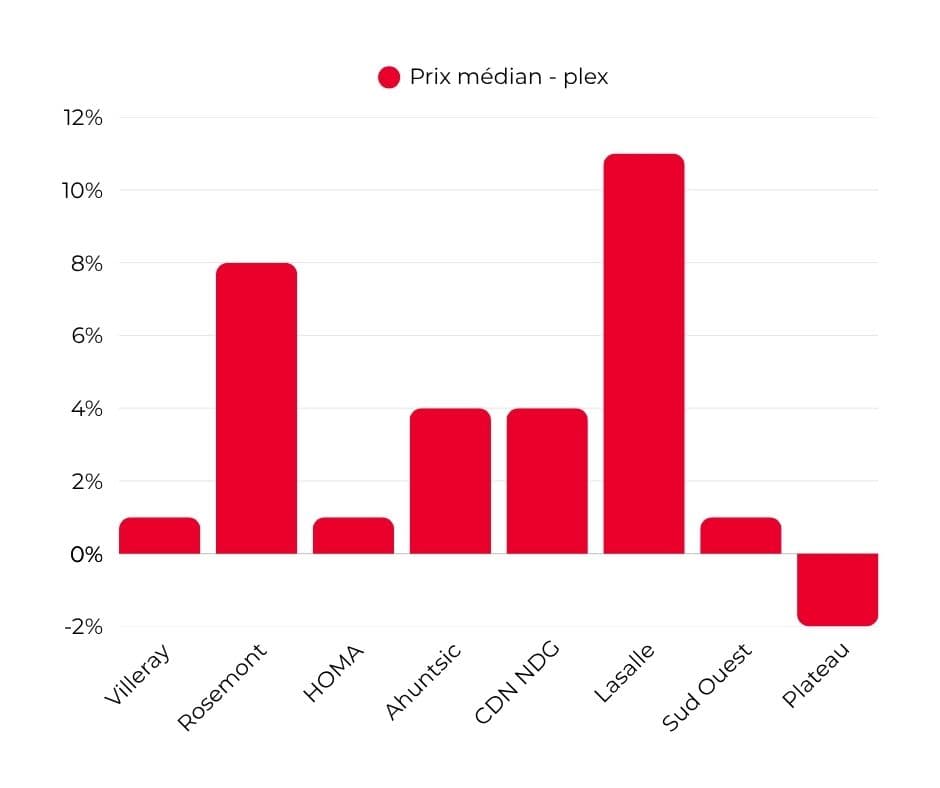
The area continues to post some of the highest absorption rates in Montreal, with peaks around 27%. Prices there are still rising strongly, by around 8% since the start of the year. Rosemont benefits from a relatively stable and gradual increase in values over the years, which often creates a healthier and more sustainable market.
Conversely, the Plateau-Mont-Royal is going through a much more difficult period.
The area, which once dominated the plex market, now shows some of its lowest absorption rates in nearly two years. Prices there are edging down and many buildings are taking longer to sell. The reasons are many: values that are already very high, an aging housing stock, significant renovation costs and a buyer pool that has become much more cautious.
But the biggest surprise may come from LaSalle.
Often less talked about in Montreal real estate discussions, the area nonetheless posts one of the strongest value increases in the plex market this year. Part of this momentum seems linked to the gradual shift in demand toward the west of Montreal, in areas that still offer a certain balance between price, rental income and quality of life.
The gross revenue multiplier.
Even though acquisition costs remain high, Montreal plexes are slightly more attractive from a financial standpoint today than they were last year. For some buyers, particularly those considering a long-term horizon, this restores a certain logic to the segment.
Of course, this does not mean that every plex is automatically a good acquisition. The market is in fact becoming more demanding. Poorly positioned buildings, those priced too ambitiously or those requiring major renovations are more likely to stay on the market longer than before.
In this context, protecting your real estate wealth is no longer just a matter of “waiting for it to go up.” You need to understand what kind of market you are actually in, and whether your area is outperforming or slowing down. And assess whether your building is still competitive in an environment where buyers are starting to have more options.
Need help interpreting the market for your project?
Our team can help you understand what this data actually means for your project.
Related content

Verdun and Nuns' Island Real Estate Market: What Q2 2026 Reveals
Single-family prices up sharply, condo prices flat but more units on the market: Centris figures for Q2 2026 show two very different markets in Verdun.

Second Quarter in Montreal: More Choice, but Good Properties Still Sell Quickly
The second quarter of 2026 confirms a change of pace in Montreal’s real estate market. Buyers have more properties to compare, and sales are slowing.

Condos: Ahuntsic Holds Up While Montreal Catches Its Breath
While Montreal’s condo market is slowing, Ahuntsic continues to show resilience, with rising prices and demand that is absorbing the additional supply.