
Is Selling Without a Legal Warranty Becoming the New Normal?
In just fifteen years, a practice once considered exceptional has found its way into nearly half of all residential sales in Quebec. What every buyer and seller should know before signing.

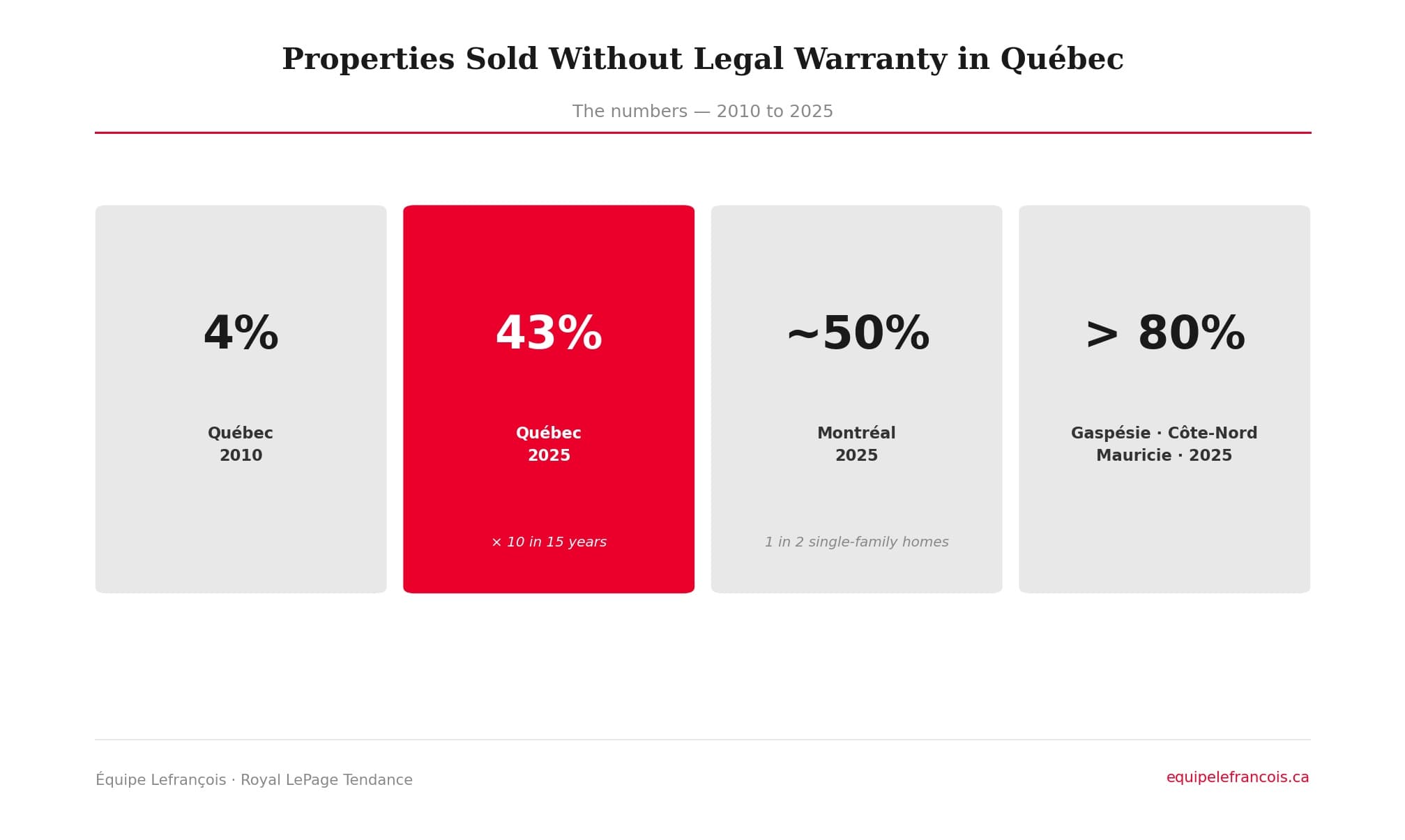
In 2010, only 4% of homes in Quebec were sold without a legal warranty. By 2025, that figure had reached 43%, an increase of more than tenfold in just fifteen years. In some regions, including Gaspésie, Côte Nord, and Mauricie, the rate now exceeds 80%. In Montreal, nearly one single family home out of two is now sold at the buyer's own risk. To understand what happened, and how to navigate this new landscape, we must first look the numbers in the face.
A Silent Shift
Fifteen years ago, selling without a legal warranty was the exception: an estate liquidation, a bank repossession, or a building destined for demolition. Today, it accounts for nearly half the market. How did this happen?
Several forces have converged. The pandemic housing frenzy between 2020 and 2022 first encouraged buyers to waive every protection imaginable in order to win multiple offer situations. Quebec society has also become increasingly litigious. Sellers now fear hidden defect lawsuits, particularly older homeowners preparing to leave their principal residence. For many, that home represents a significant portion of their wealth, and the idea that such an asset could later become a liability is simply unacceptable.
The housing stock is also aging. Offering a legal warranty becomes increasingly risky when selling an eighty year old home. Finally, a ratchet effect has emerged, a phenomenon we will return to shortly.
The Pandemic Frenzy Paradox
Here is a little known fact worth examining.
According to JLR, an Equifax company specializing in real estate analytics, a home sold with a legal warranty in 2016, before the pandemic, typically sold for between 8% and 11% more than a comparable property sold without one. This makes sense. A legal warranty has value, and the market prices it accordingly.
Yet during the market frenzy of 2020 and 2021, that premium narrowed to only 4% to 7%.
Why?
When ten buyers are competing for a single property, the seller holds all the leverage. A buyer willing to waive the legal warranty no longer receives the discount they might otherwise expect because several competing buyers are making exactly the same concession.
A seller's market temporarily neutralizes the negotiating advantage normally associated with excluding the legal warranty.
"The price gap between properties sold with and without a legal warranty narrows when the market overheats. It widens again when market conditions become more balanced."
2025: A Return to Pre Pandemic Norms
This is where our own internal analysis provides fresh insight.
We examined more than 10,000 single family home transactions completed on the Island of Montreal in both 2019 and 2025, before and after the pandemic period.
The results are unambiguous.
In 2025, within a market that has become considerably more balanced than it was at the height of the frenzy, the discount associated with the absence of a legal warranty has returned to its pre pandemic level.
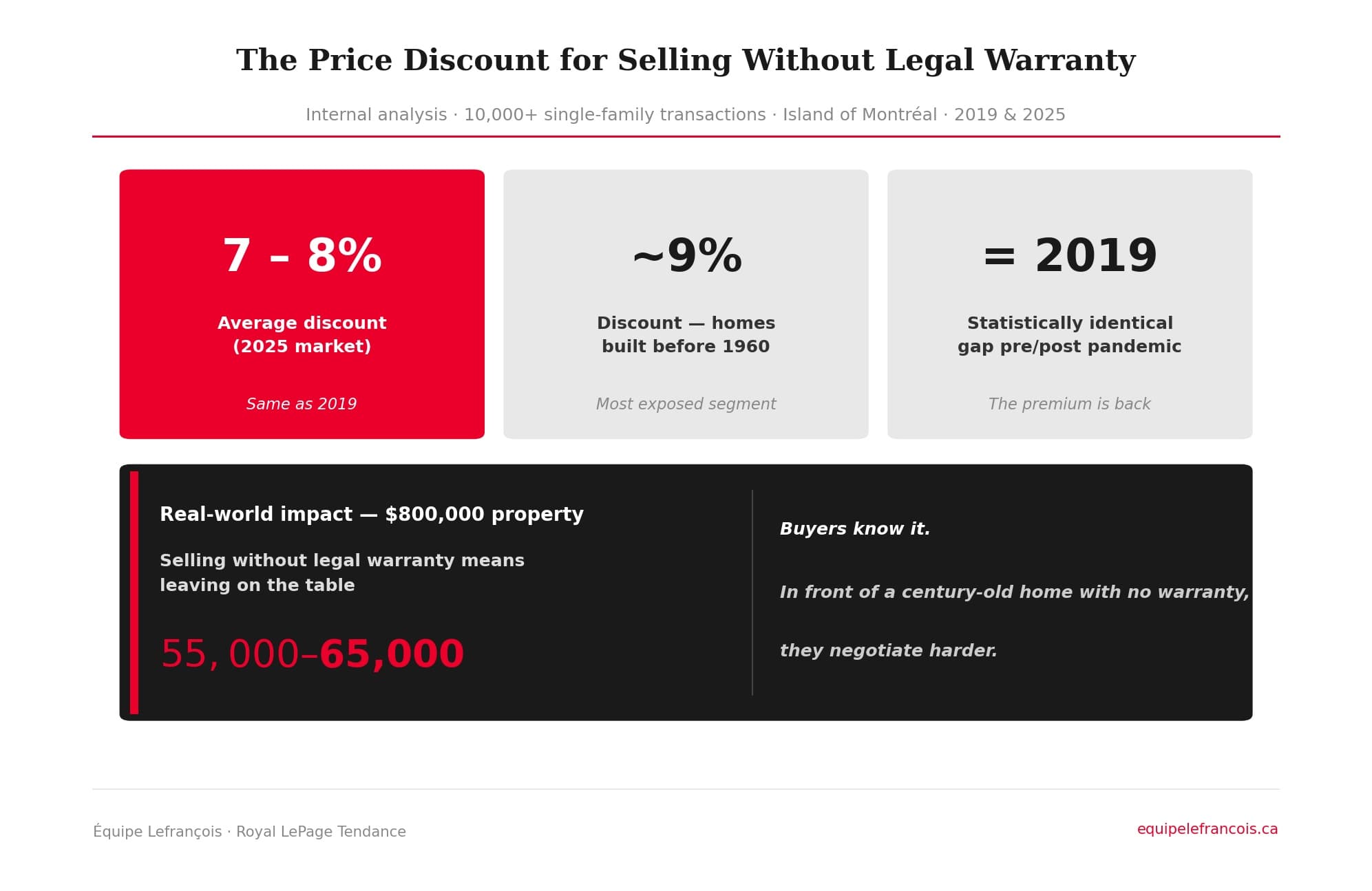
In practical terms, a home sold with a legal warranty now commands approximately 7% to 8% more than a comparable property sold without one.
More importantly, that gap is statistically identical to what we observed in 2019.
The pandemic exception has closed. The value premium attached to the legal warranty has fully reasserted itself.
What This Means in Practical Terms
For an $800,000 property, selling without a legal warranty now represents a reduction in value of approximately $55,000 to $65,000.
The effect is even more pronounced for older homes built before 1960, where the discount approaches 9%.
Counterintuitively, the very properties for which sellers most readily waive the legal warranty, believing the risk to be manageable, are often those that suffer the largest price reductions.
Buyers understand this. Faced with a century old property sold without protection, they negotiate more aggressively.
The Ratchet Effect: A Door That Never Closes
This may be the most important observation when considering the future.
Once a property is purchased without a legal warranty, it is almost always resold without one.
There are two reasons for this.
First, the new owner no longer possesses the same legal leverage. Following the Quebec Court of Appeal's decision in Blais v. Laforce in 2022, a complete waiver of the legal warranty permanently breaks the chain of transmission. A buyer who acquires a property at their own risk cannot later resell that property with a full legal warranty. The warranty was extinguished at the moment of purchase.
In a sense, the property permanently leaves the protected universe.
Second, the explanation is simply human nature. People are generally reluctant to provide a protection to a future buyer that they themselves did not receive when they purchased the property.
The consequence is mechanical.
The pool of properties sold without a legal warranty can only grow. It never truly shrinks.
Every year, tens of thousands of homes are added to this category on an effectively irreversible basis.
Even if the market were to slow dramatically tomorrow, and even if bidding wars disappeared entirely, the proportion of sales without a legal warranty would likely never return to 2010 levels.
The trend moves in one direction and reinforces itself over time.
There is a very real possibility that Quebec's residential market gradually evolves toward the model found across the rest of Canada and the United States, with the notable exception of Louisiana.
The legal warranty of quality is a concept specific to jurisdictions governed by civil law. In common law jurisdictions, residential properties are generally sold with little or no equivalent statutory protection.
What Comes Next? A More Uncertain Future Than It Appears
The future of Quebec's legal warranty system is far from settled.
Three scenarios currently coexist, and the outcome will depend as much on legislators as on market forces.
Scenario 1: The Trend Continues
Under the influence of the ratchet effect, more than half of all residential transactions could occur without a legal warranty within five to seven years.
This is simply the mechanical projection of current dynamics.
Several regions of Quebec have already crossed that threshold.
Scenario 2:
Recent legal scholarship, including work published by the University of Sherbrooke Law Review in 2025, argues for stronger regulation of exclusion clauses.
A future reform of the Civil Code could restrict the exclusion of legal warranties to situations where it is genuinely justified, such as estate sales, financial repossessions, or properties intended for demolition.
The debate remains open.
Scenario 3: The Market Develops Its Own Solutions
Programs such as ACQ Résidentiel and insurance products like Royal LePage's Royal Protection already allow sellers to reduce their exposure.
If these products become more widespread and additional insurers enter the market, the trend could stabilize or even partially reverse.
Beyond the Statistics: Practical Advice
For sellers, the calculation is increasingly clear.
Selling without a legal warranty reduces the sale price by approximately 7% to 8% on average.
On a typical transaction, this can represent tens of thousands of dollars.
In certain circumstances, accepting this discount may be a rational and informed decision. However, it is rarely a choice that should be made automatically or simply for convenience.
A Wealth Protection Tool
The legal warranty of quality should often be viewed as a wealth preservation and risk management tool once the family home has been sold.
For most households, the principal residence represents a major asset. A hidden defect claim can involve substantial sums, amounts that may significantly affect quality of life during retirement.
What makes this issue particularly challenging is that the legal warranty of quality is not subject to a fixed expiration period.
It continues to protect the buyer against hidden defects, whether or not the seller was aware of them at the time of sale.
A hidden defect is a defect, known or unknown to the seller, that the buyer can prove existed at the time of the transaction and that would have materially affected the purchase decision or purchase price had it been known.
This indefinite duration is precisely what makes the legal warranty a genuine Sword of Damocles hanging over the seller.
If the decision is made to sell without a legal warranty in order to reduce financial exposure, several important steps should be taken to minimize the resulting impact on the final sale price.
The 7% to 8% discount represents an average. Sellers who prepare thoroughly and implement targeted strategies can often reduce that impact substantially.
For buyers, the discount offered by the seller is never a gift. It represents the transfer of risk that may one day need to be assumed personally.
The pre purchase inspection process should therefore be strengthened and every available protection should be considered.
In all cases, this decision deserves more than a simple checkbox on a form.
This is precisely where the role of a real estate broker becomes essential: asking the right questions, presenting the data, identifying alternatives that exist between a full legal warranty and a complete exclusion, and helping each party choose the option most aligned with their circumstances.
For Further Reading
We make two complementary research documents available to our clients:
A 26 page in depth report examining the phenomenon across Quebec, including its history, geography, legal framework, and the Blais v. Laforce decision.
Our proprietary statistical study covering more than 10,000 single family home transactions on the Island of Montreal, including all detailed calculations.
Both documents are available upon request, with no obligation, at info@equipelefrancois.ca.
Thinking about selling your property?
Our team can evaluate your property and support you at every step of the sale.
Related content

Selling a house in the Town of Mount Royal in 2026: the owner's strategic guide
Selling a house in the Town of Mount Royal isn't quite like selling anywhere else in Montréal.

Why TMR Market Requires Patience and Precision
The TMR market remains resilient: despite longer selling times, prices have remained stable due to the limited supply of available properties. In a more uncertain economic environment, buyers are taking more time to make decisions.

Selling the Family Home: What Nobody Tells You Before You Do It
There is one thing no one tells you when the idea of selling the family home begins to take hold: it is not just a real estate decision. It is a life transition. And while you are navigating it, the market keeps moving.