
Sales down, prices up: what the Montréal real estate market is really saying in May 2026
Listings up, sales slightly down, a median price that remains firm and short selling times: here is what the numbers reveal about Montréal's single-family real estate market in spring 2026.

At first glance, the numbers seem to contradict each other. Sales are slowing, inventory is climbing… yet prices keep rising. For anyone skimming the headlines, it's confusing. For anyone who takes the time to cross-reference the data, it's exactly what you would expect in a market that is changing speed without changing direction.
Here is what the four indicators that matter are really saying.
Four numbers, one story
Inventory is rising, but from a very low base. Active listings have exceeded 2025 levels every month since January: 2,227 properties available in May, compared with 2,148 a year earlier. It's an underlying trend: more supply, more choice. But inventory remains historically thin: according to the QPAREB, it is still well below its ten-year average.
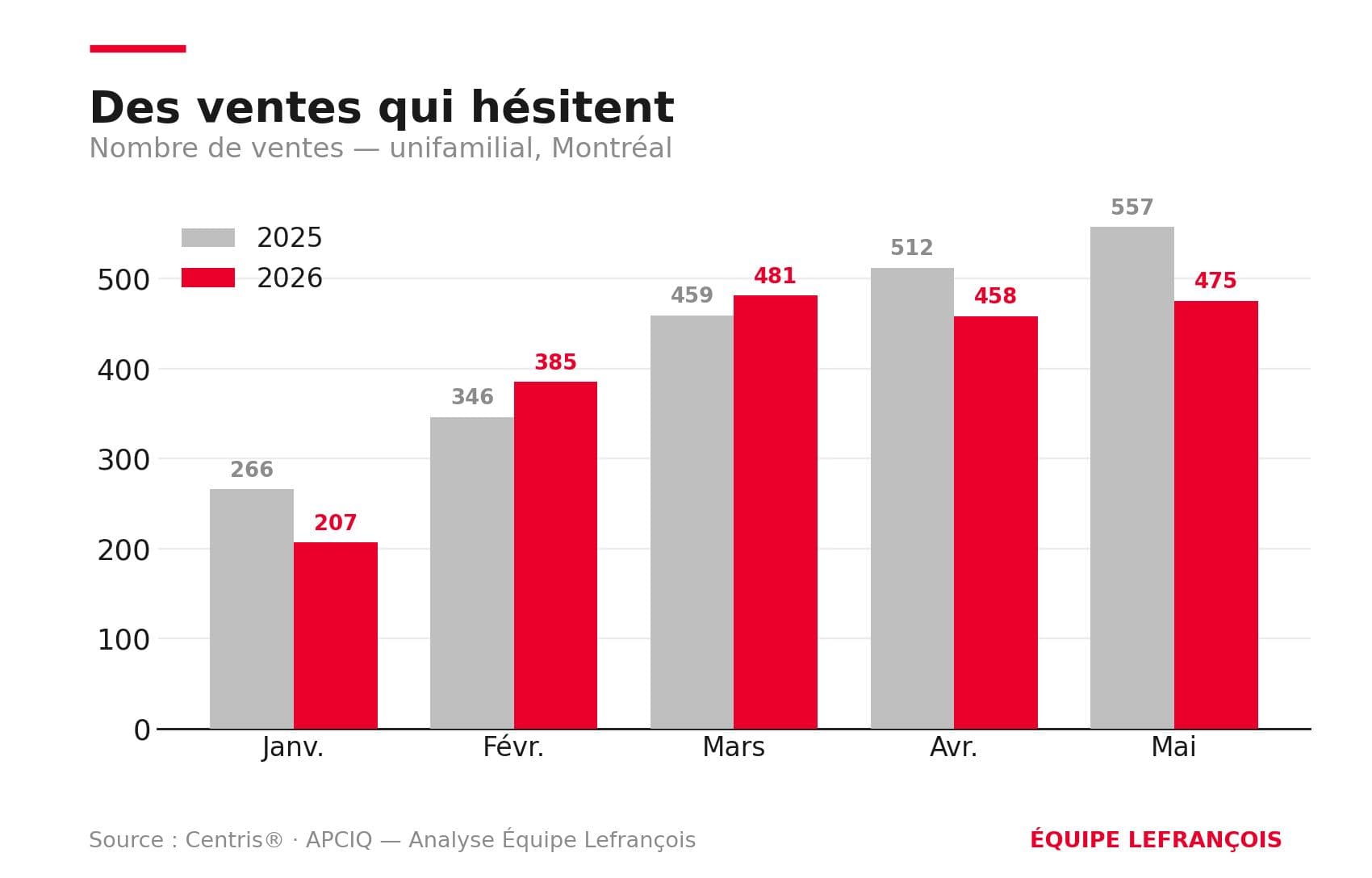
Sales are hesitating. The picture is mixed. February and March 2026 outpaced 2025, but January, April and especially May declined: 475 sales in May versus 557 last year, nearly 15% fewer. The usual “spring acceleration” did not fully materialize.
Prices are holding and climbing. The median price jumped to $878,750 in April (compared with $800,000 in 2025), before easing slightly to $784,500 in May. Over the spring as a whole, the trend remains upward.
And selling times? Surprisingly short. A well-positioned property sold in 13 days in March, and in 17 in April and May. In a market that is “slowing down,” this is the detail that changes everything: buyers are there, and they act quickly when the price is right.
Taken together, these four indicators do not contradict each other: they tell the story of a transition, not a reversal. Supply is recovering, but from a historic low. Demand is present, but disciplined. Prices are holding, supported by scarcity rather than frenzy. And the speed of execution proves that buyers haven't deserted the market; they have simply become more demanding. In short, the market isn't closing: it is rebalancing, slowly, and still in favour of the well-prepared seller.
The absorption rate: the real thermometer
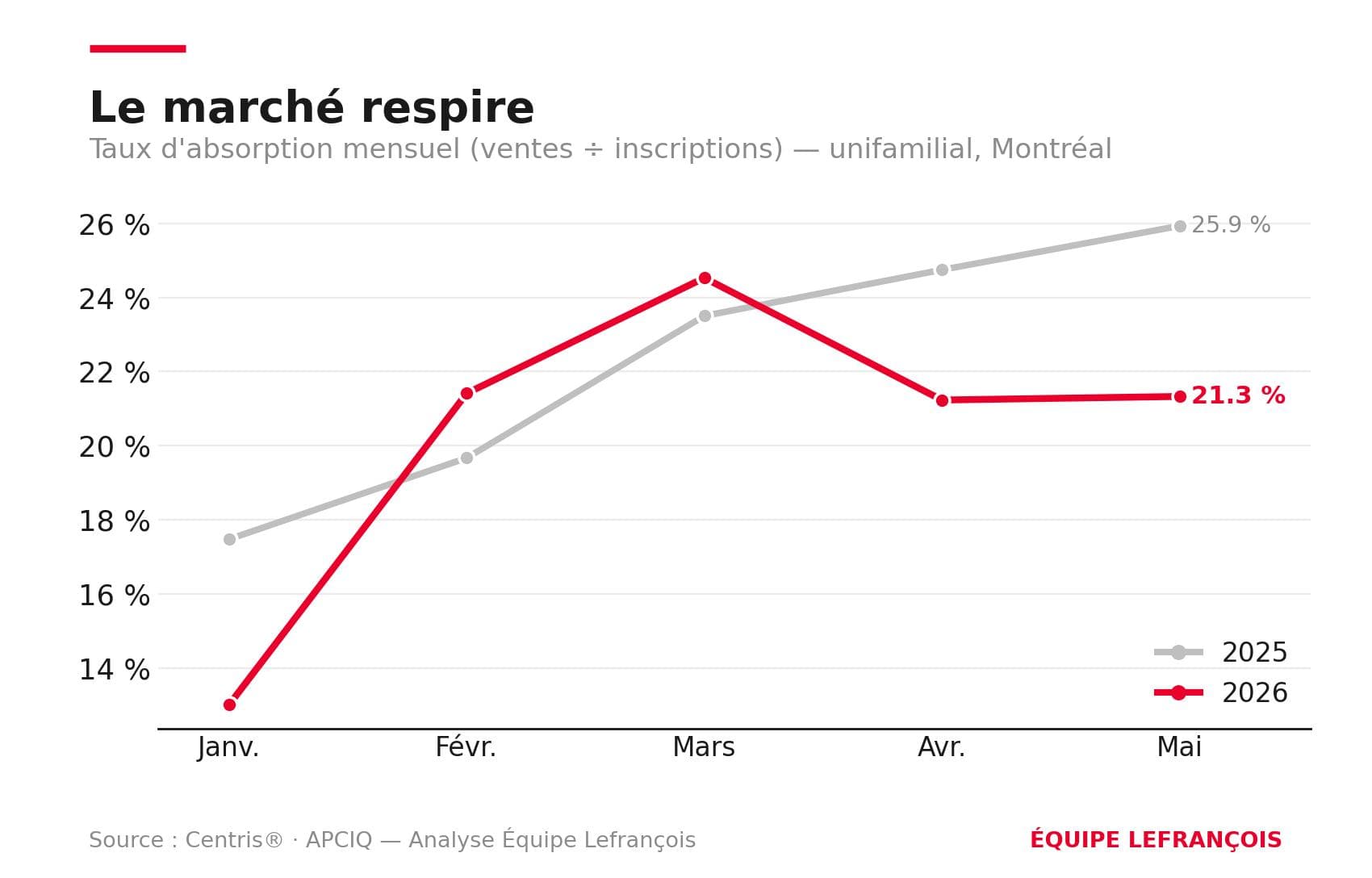
To get past impressions, one ratio settles the debate: the absorption rate, i.e., the share of inventory sold each month. In practical terms, you divide the month's sales by the available listings: the higher the percentage, the more the market favours the seller.
| Month | 2025 | 2026 |
|---|---|---|
| January | 17.5% | 13.0% |
| February | 19.7% | 21.4% |
| March | 23.5% | 24.5% |
| April | 24.7% | 21.2% |
| May | 25.9% | 21.3% |
The difference shows less in the average (about 22% this spring, versus 23.5% last year) than in the trajectory. In 2025, absorption climbed month after month until it neared 26% in May, a market that was overheating. In 2026, it plateaus around 21–24%, then falls back at the end of spring. The seasonal momentum has faded.
Expressed as the time needed to sell off inventory, it leads to the same conclusion: in spring 2025, the market was absorbing its inventory in about 4 months: tight, almost frenzied. In spring 2026, this period stretches to about 4.7 months. The nuance is crucial: we remain firmly in seller's territory (balance is rather around 6 to 8 months), but the pressure is easing. The market is breathing.
Put plainly: the seller keeps the advantage, but no longer has it automatically. The most telling proof came in January 2026, when the median selling time climbed to 49 days. The market's message is crystal clear: it rewards the right price and punishes optimistic overpricing. This is not a soft market. It is a selective one.
What the economy adds to the equation
This buyer discipline doesn't come out of nowhere. On June 10, the Bank of Canada held its policy rate at 2.25% for the fifth consecutive time. Stable, predictable financing, well below the 2023 peaks, provides a solid floor for demand.
But the sky isn't entirely clear. Inflation rose back to 2.8% in April, driven by energy against the backdrop of conflict in the Middle East, which is delaying potential rate cuts. On the employment front, Québec posted 5.6% unemployment in May, down but volatile, with the Montréal region running higher, around 6.7%. Add trade uncertainty with the United States, and households' caution is easy to understand.
It is precisely this combination, stable rates but strained purchasing power, that produces a two-speed market: enough confidence to buy, enough caution not to overpay.
Our forecasts for the rest of 2026
Everything points to a soft landing, not a correction. Inventory should continue to rebuild, but from such scarcity that prices for well-located single-family homes will remain firm: pent-up demand, high construction costs and rate stability together form a floor. The QPAREB also anticipates slightly lower activity in Montréal in 2026, with prices still rising, albeit more moderately.
The scenario to watch: if unemployment slides toward 7% and energy-driven inflation freezes the Bank of Canada, affordability will remain the central issue and demand could run out of steam further. Conversely, a geopolitical calm would reopen the door to rate cuts and a market rebound by 2027.
What this means for you
Selling? The first-day list price has never mattered more. The data is unequivocal: well positioned, you sell in two weeks; poorly positioned, you sit. In a market where buyers have more choice, preparation, presentation and positioning backed by the numbers make all the difference. And the current window, still favourable to sellers, won't stay this wide indefinitely.
Buying? You have leverage you didn't have in 2025: more inventory, more time to think, more room to negotiate. But be careful: quality single-family homes remain scarce, and the best properties, when well priced, still go fast. Get your financing ready, stay decisive, and base your thinking on what you can really afford rather than the maximum you qualify for. With rates stable, don't count on an imminent drop.
A market full of nuance is less forgiving of approximations. That is exactly where analysis takes precedence over intuition.
Need help interpreting the market for your project?
Our team can help you understand what this data actually means for your project.
Related content

Verdun and Nuns' Island Real Estate Market: What Q2 2026 Reveals
Single-family prices up sharply, condo prices flat but more units on the market: Centris figures for Q2 2026 show two very different markets in Verdun.

Second Quarter in Montreal: More Choice, but Good Properties Still Sell Quickly
The second quarter of 2026 confirms a change of pace in Montreal’s real estate market. Buyers have more properties to compare, and sales are slowing.

Condos: Ahuntsic Holds Up While Montreal Catches Its Breath
While Montreal’s condo market is slowing, Ahuntsic continues to show resilience, with rising prices and demand that is absorbing the additional supply.