
Montreal Welcome Tax in 2026: Calculation, Exemptions and the First-Time Buyer Credit
Montreal's 2026 transfer-duty rates, worked examples and Quebec's new tax credit of up to $5,875 for first-time buyers: what to plan for in your purchase budget.
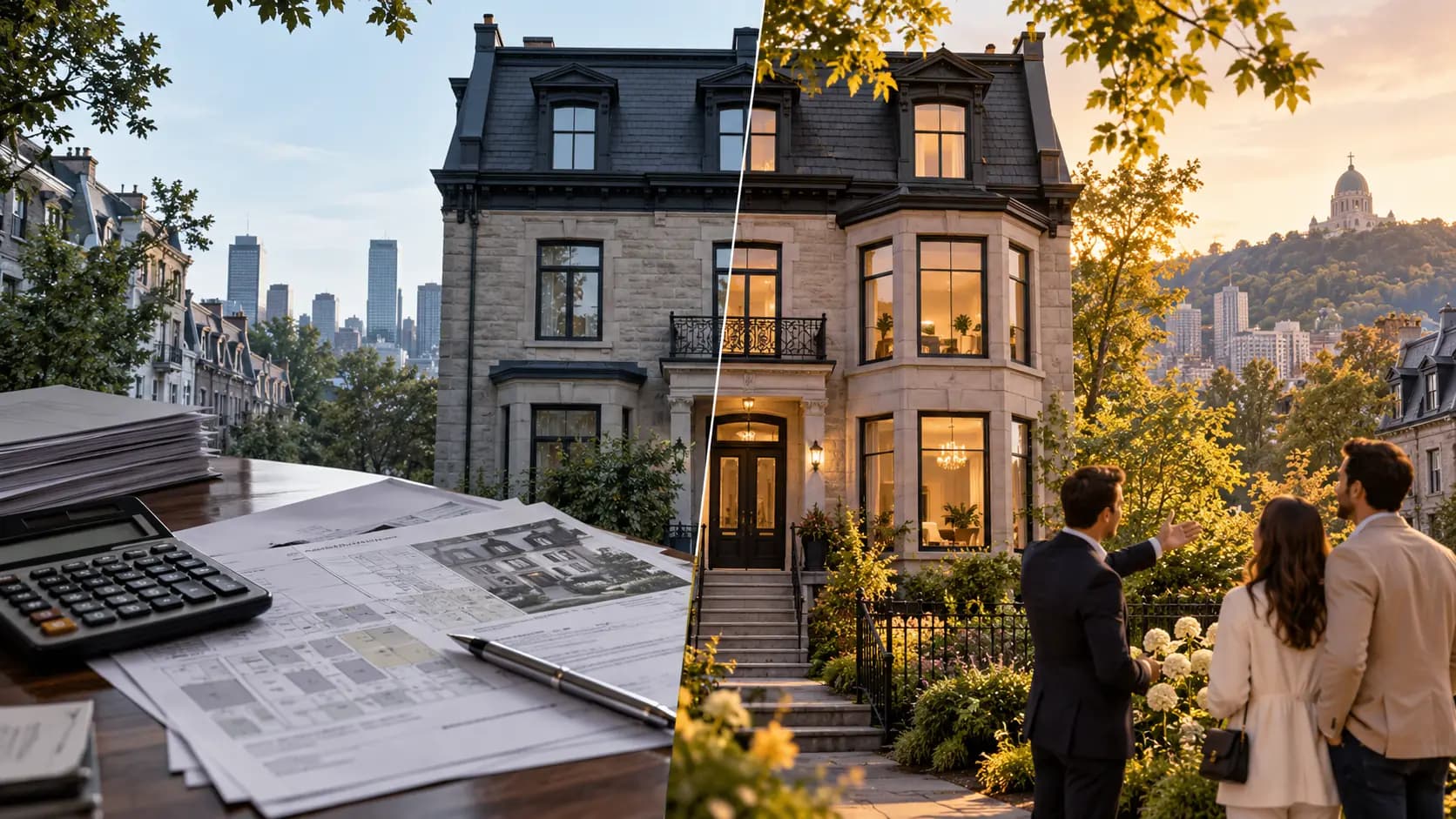
The "welcome tax" is one of the costs buyers most often leave out of their budget. You don't pay it at the notary's office: the municipality sends you a bill a few weeks or months after the sale. In Montreal, the amount depends on value brackets that change every year. And in 2026 there is an important new measure for first-time buyers: a refundable tax credit of up to $5,875, announced by Quebec's Ministère des Finances on April 17, 2026.
This guide explains how the tax is calculated in Montreal, who is exempt and how the new credit works, with worked examples.
At a glance
- Its official name is the property transfer duty (droit sur les mutations immobilières). The buyer pays it to the municipality where the property is located.
- It is calculated on the taxable base: the highest of the price paid, the price stated in the deed, and the assessment-roll value multiplied by the comparative factor.
- In Montreal in 2026, rates range from 0.5% to 4% depending on the value bracket.
- First-time buyers can recover up to $5,875 through the home-ownership access tax credit. The credit is reduced above $750,000 and drops to zero at $1,000,000.
How is the taxable base determined?
According to the City of Montreal (https://montreal.ca/articles/comment-sont-calcules-les-droits-sur-les-mutations-immobilieres-9279), the taxable base is the highest of these three amounts:
- the sale price of the property (excluding GST and QST);
- the amount stated in the deed of sale;
- the value on the property assessment roll, multiplied by that year's comparative factor.
For 2026, Montreal's comparative factor is 1.00. In practice, if you pay less than the assessed value, the assessed value becomes the base. The tax is not always calculated on your purchase price.
Montreal's 2026 rates
Property transfer duties, City of Montreal, transfers made on or after January 1, 2026
- Up to $62,900 — Rate: 0.5%
- $62,900 to $315,000 — Rate: 1%
- $315,000 to $552,300 — Rate: 1.5%
- $552,300 to $1,104,700 — Rate: 2%
- $1,104,700 to $2,136,500 — Rate: 2.5%
- $2,136,500 to $3,113,000 — Rate: 3.5%
- $3,113,000 and over — Rate: 4%
Each rate applies only to the portion of the value that falls within its bracket. The City's own example for a $700,000 base: $314.50 + $2,521 + $3,559.50 + $2,954 = $9,349.
Note: these are the City of Montreal's rates. Other municipalities on the island, such as the Town of Mount Royal (TMR) or Westmount, set their own brackets and rates. Always check with the municipality where the property is located.
The 2026 home-ownership access tax credit
According to Revenu Québec (https://www.revenuquebec.ca/fr/salle-de-presse/nouvelles-fiscales/details/2026-04-21/instauration-dun-credit-dimpot-remboursable-pour-acces-a-la-propriete/), this refundable credit is available starting with the 2026 taxation year to individuals who acquire a first principal residence, or who acquire a more accessible home because of a severe disability. It reimburses the transfer duty paid as follows:
- 100% of the first $5,000 paid;
- 25% of the next $3,500, i.e. up to $875 more;
- for a maximum of $5,875.
The credit is reduced by 2.35% of the portion of the taxable base above $750,000, so it reaches zero at a base of $1,000,000.
Who counts as a first-time buyer?
A home is a first home if, during the period starting at the beginning of the fourth calendar year before the purchase and ending the day before it, neither you nor your spouse owned a home you lived in. You or your spouse must also have paid the transfer duty. If several people qualify for the same home, their combined credit cannot exceed what a single person would receive.
Advance payment
Instead of waiting for your tax return, you can request an advance payment if you live in Quebec, the duty has been paid, the taxable base does not exceed $1,000,000, the expected credit is over $1,000 and you agree to direct deposit. The request must be made no later than December 1 of the year concerned. Revenu Québec publishes the application details on its website.
Examples in Montreal in 2026
Welcome tax and first-time buyer credit, Montreal examples for 2026 (calculated by Équipe Lefrançois from the official rates)
- $400,000 — Transfer duty: $4,110; Maximum credit (first-time buyer): $4,110; Net cost: $0
- $550,000 — Transfer duty: $6,360; Maximum credit (first-time buyer): $5,340; Net cost: $1,020
- $700,000 — Transfer duty: $9,349; Maximum credit (first-time buyer): $5,875; Net cost: $3,474
- $850,000 — Transfer duty: $12,349; Maximum credit (first-time buyer): $3,525; Net cost: $8,824
- $1,000,000 — Transfer duty: $15,349; Maximum credit (first-time buyer): $0; Net cost: $15,349
- $1,500,000 — Transfer duty: $27,326; Maximum credit (first-time buyer): $0; Net cost: $27,326
Amounts are rounded to the dollar and assume the taxable base equals the price paid and that the buyer qualifies for the credit. For a $500,000 condo, for example, the duty is $5,610, fully covered by the credit.
Main exemptions
The Government of Quebec (https://www.quebec.ca/gouvernement/gestion-municipale/finances-fiscalite-municipales/fiscalite/droits-mutations-immobilieres) provides exemptions in situations including:
- transfers between direct-line relatives (parents, children, grandparents, grandchildren), between spouses, or between parents-in-law and a son- or daughter-in-law or stepchild;
- transfers between former de facto spouses within the legal time limits;
- property that is part of a registered farm;
- a taxable base under $5,000;
- certain transfers involving corporations or partnerships, subject to conditions.
Even when exempt, a municipality may charge a "compensatory duty" of up to $200.
When and how do you pay?
The municipality sends the bill after the deed is registered. In Montreal it is payable in a single instalment within 30 days of being sent, and interest applies to late payments. Build it into your budget from the start, alongside the down payment, notary fees, inspection and moving costs. Our expense checklist when buying a new property lists them all.
Frequently asked questions
Who pays the welcome tax, the buyer or the seller?
The buyer. The transfer duty is collected by the municipality from anyone who acquires a property on its territory.
How much is the welcome tax on a $700,000 home in Montreal in 2026?
According to the City of Montreal's own example, a $700,000 taxable base gives a transfer duty of $9,349. An eligible first-time buyer can then recover up to $5,875 through the home-ownership access tax credit.
Does the credit apply to a property over $1 million?
No. The credit is reduced by 2.35% of the portion of the taxable base above $750,000 and is zero from $1,000,000.
Do Montreal's rates apply in the Town of Mount Royal or Westmount?
No. TMR and Westmount are separate municipalities that set their own brackets. Check with the municipality where the property is located.
Related reading
Sources, method and limitations
- City of Montreal, "Comment sont calculés les droits sur les mutations immobilières" (https://montreal.ca/articles/comment-sont-calcules-les-droits-sur-les-mutations-immobilieres-9279): 2026 rates, brackets, comparative factor and payment deadline.
- Revenu Québec, "Instauration d'un crédit d'impôt remboursable pour accès à la propriété", April 21, 2026 (https://www.revenuquebec.ca/fr/salle-de-presse/nouvelles-fiscales/details/2026-04-21/instauration-dun-credit-dimpot-remboursable-pour-acces-a-la-propriete/): eligibility, calculation, reduction and advance payment.
- Quebec Ministère des Finances, information bulletin 2026-2 (https://cdn-contenu.quebec.ca/cdn-contenu/adm/min/finances/publications-adm/Bulletins/FR/BULFR_2026-2.pdf).
- Government of Quebec, "Droits sur les mutations immobilières" (https://www.quebec.ca/gouvernement/gestion-municipale/finances-fiscalite-municipales/fiscalite/droits-mutations-immobilieres): exemptions and compensatory duty.
The examples in the table were calculated by Équipe Lefrançois from the official 2026 rates. They do not replace the municipality's bill or Revenu Québec's notice. Brackets are indexed every year. Information current as of October 5, 2026; this is not tax or legal advice.
Planning a purchase in Montreal and want a complete budget, welcome tax included? Talk to a broker on our team or call us at 514-700-1221.

Planning a real estate purchase in Montreal?
Our team can help you find the property that matches your project.
Related content
Condo, Duplex or House in Montreal: How to Choose Based on Your Budget and Plans
Financing, recurring costs, responsibilities and resale: a practical comparison of condos, owner-occupied plexes and houses for buying in Montreal.
Why Ahuntsic Remains One of the Most Consistent Areas to Settle Down Long Term
In a Montreal where densification is accelerating, Ahuntsic retains a rare residential stability. For a long-term plan, this consistency becomes a genuine strategic advantage.
Going green in Ahuntsic: what impact on your property value… and your taxes?
Ahuntsic's green shift is improving quality of life through bike paths, trees and safer spaces. The result: property values are climbing… but so are property taxes, a direct reflection of this new appeal.