
Has the luxury real estate market become affordable?
Despite the general rise in property prices, the luxury property market has become more accessible since 2017 due to the evolution of different market segments.
The question may come as a surprise, but the answer is essentially yes: the luxury property market hasn't been this accessible since 2017. Admittedly, property prices have followed an upward trend overall, and median prices are now significantly higher than in 2017 in all market segments. However, a closer look at the individual segments shows that price differentials have varied significantly and sometimes unexpectedly over the past few years.
A dynamic influenced by economic instability
Financial market analysts often assert that periods of high volatility generate opportunities. Although the real estate market does not have the same liquidity as the stock or currency markets, it remains a financial asset influenced by economic, social and political conditions that modulate supply and demand.
The pandemic, followed by a rapid rise in interest rates and a redefinition of buyers' needs, profoundly altered the balance of the real estate market. First, there was a craze for single-family homes, responding to an increased need for space, then a marked slowdown in demand as interest rates climbed.
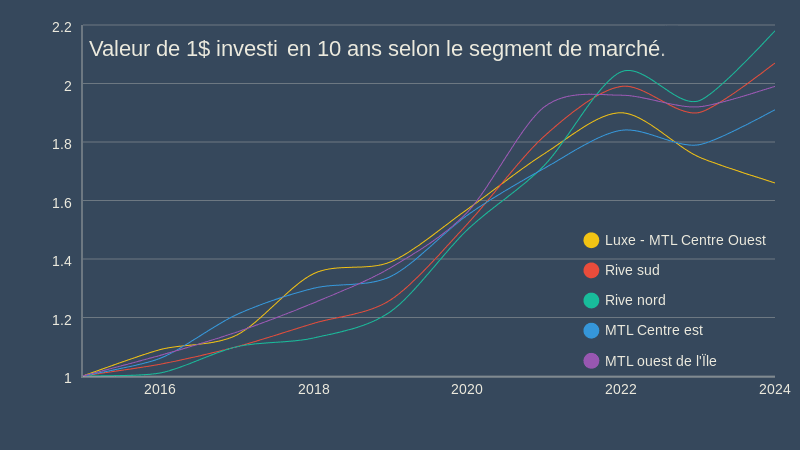
Segmenting properties by location, and distinguishing between the first-time buyer and upgrade markets, reveals marked differences in their recent evolution. Chart 1 illustrates the 10-year return on each dollar invested by sector. This analysis is based on a relative comparison between similar investments, rather than on absolute values. Obviously, a property in Westmount is more expensive than one in Saint-Hilaire, and its gross yield is higher. What's important here, however, are the implications for those considering migrating from one segment to another.
Marked geographical disparity
One striking observation is the remarkable performance of the North Shore and South Shore markets. Long lagging behind, these sectors exploded from 2021 onwards, notably with the exodus of buyers leaving Montreal condos for homes in the suburbs. This phenomenon confirms the demographic trends observed.
On the other hand, why did established neighborhoods like Westmount, Mont-Royal and Outremont underperform? Is the explanation sociological or financial? The pandemic has undoubtedly changed buyers' priorities, but the answer lies mainly in a combination of lifestyle and financial factors.
A well-defined purchasing cycle
Empirically, the evolution of real estate needs follows a relatively stable cycle:
- Young professionals: buying a condo in the city.
- Arrival of children: transition to a single-family home in the suburbs, often for budgetary reasons.
- Increased financial stability: possibility of acquiring a more luxurious property or second home.
- Approaching retirement: return to a condo in the city or a main residence in the country.
Although this pattern is a generalization, it reflects major market trends. Buying a second home or luxury property in Montreal is more a matter of choice than necessity. To take this step, confidence in the economy, financial stability and reasonable financing costs are essential. And therein lies the explanation.
In recent years, consumers have increased their spending on travel and leisure, faced higher interest rates, and felt more fragile economic confidence than before the pandemic. These conditions have reduced the number of active buyers in the luxury market.
What are the prospects for the future?
Markets tend to self-regulate. Chart 2 illustrates the evolution of the median cost to move from the North Shore to Montreal's luxury neighborhoods. We're essentially back to 2017 values, which represents a rare opportunity. With lower interest rates and an expanding economy, a return to the city seems likely for some buyers.
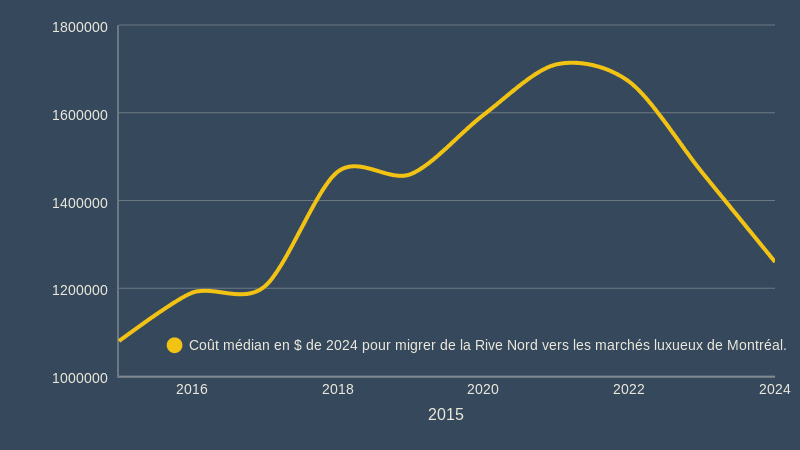
Today, it is 26% cheaper to access these sought-after neighborhoods than it will be in 2021. What's more, the luxury market remains tight: land supply is limited by the lack of new construction possibilities. A moderate increase in demand could quickly reverse this trend. Transactions recorded over the last three months already confirm this recovery.
It remains to be seen whether economic conditions and geopolitical tensions will influence this long-term dynamic. Nevertheless, we remain optimistic: if your budget allows, there's a real opportunity to be seized.
Planning a real estate purchase in Montreal?
Our team can help you find the property that matches your project.
Related content
Why Ahuntsic Remains One of the Most Consistent Areas to Settle Down Long Term
In a Montreal where densification is accelerating, Ahuntsic retains a rare residential stability. For a long-term plan, this consistency becomes a genuine strategic advantage.
2026 Kitchens: Craftsmanship, Sustainability, and Technology
In 2026, the kitchen becomes more vibrant: a return to authentic materials, organic colors, discreet technology, multifunctional spaces built around a large island, sustainability, and scenographic lighting.
Buying a Condo in Montreal Now: 3 Neighbourhoods of Opportunity (Griffintown, LaSalle, Nuns’ Island)
Montreal’s condo market is rebalancing: more listings, less pressure. Where and how to negotiate smartly (Griffintown, LaSalle, Nuns’ Island) using comparables, DOM and concessions.